Asking vs. Saying Yes
End-to-end mixed-methods study for Habitat for Humanity to figure out why peer-to-peer volunteer recruitment stalled, and how to fix it.
Client: Habitat for Humanity, Lawrence, KS
Role: Lead researcher (end-to-end)
Methods: Semi-structured interviews, survey experiment (N = 151), online A/B experiment (N = 200), text analysis, mediation analysis
The Problem
Habitat for Humanity’s local chapter had healthy donation numbers but a persistent plateau in new volunteer sign-ups. Their peer-to-peer social media campaigns weren’t converting. Leadership knew people said they cared — the attitude was there. The behavior wasn’t.
This was a conversion problem, not an awareness problem.
The research question: why do people who care about a cause hesitate to invite others, and what messaging changes can close that gap?
Research Process
Phase 1: Exploratory Interviews
Two rounds of semi-structured interviews with four leadership team members and seven executive-level donors surfaced a consistent pattern: friction and uncertainty around asking others.
“It’s something very important to me, but I don’t know if others care as much as I do.” — Executive donor
“People show up to fundraisers and auctions, but we struggle expanding the network.” — HfH Director
This pointed toward a psychological mechanism: social misprediction — askers underestimate how willing others are to say yes.
Phase 2: Survey Research
Surveyed 151 local adults (convenience sample). Primary focus was an “Invite Likelihood” measure and open-ended responses about volunteering motivations.
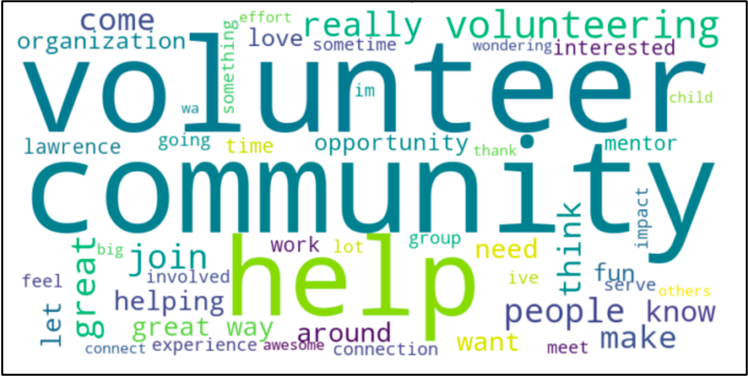
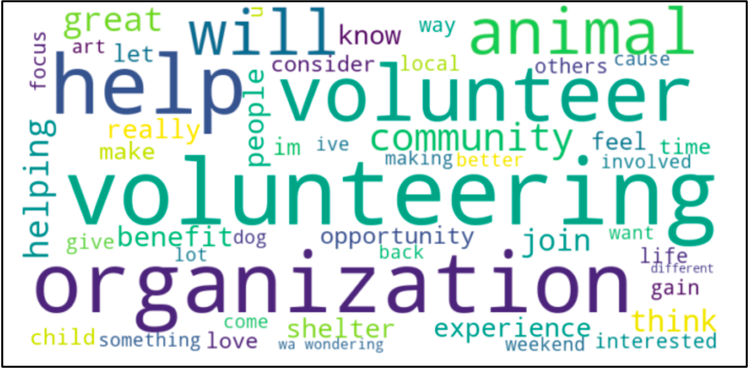
Text analysis of open-ended responses revealed that volunteers and non-volunteers described volunteering in meaningfully different language. Volunteers emphasized community connection and relationships; non-volunteers centered on organizational mission.
Phase 3: Experiment and Mediation Analysis
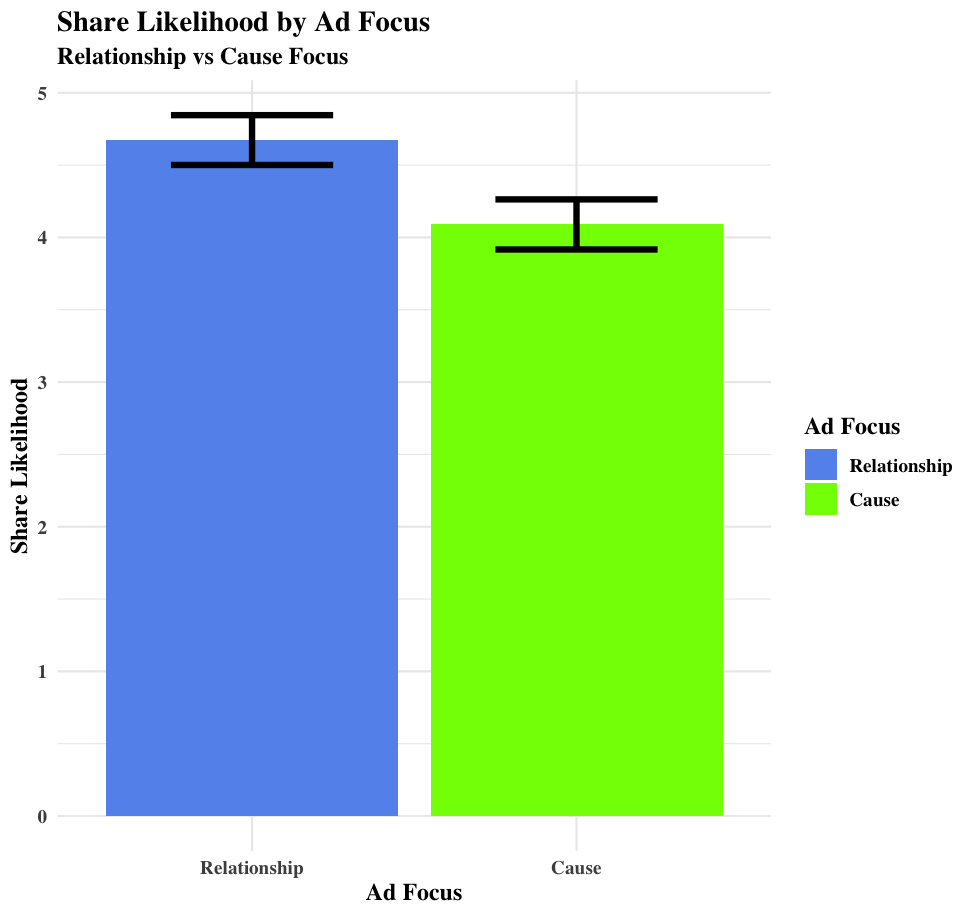
Online experiment (N = 200, sample size from power analysis and pretests) tested whether messaging framed around relationship norms (“volunteer with your friends”) outperformed messaging framed around the cause (“support families in need”).
Mediation analysis confirmed the mechanism: being in the “responder” role (vs. the “asker” role) significantly increased relationship focus, which in turn drove higher volunteer likelihood. Cause focus did not mediate the effect.
Insights and Recommendations
Findings were translated into concrete stakeholder recommendations:
- Reduce the “asking cost” — reframe invitations as a social gesture, not a mission pitch
- Highlight relationship norms (“friends help friends”) rather than leading with the cause alone
- Prioritize existing volunteers for peer-to-peer outreach; they are more likely to respond to the ask
Ad templates built on relationship-focused framing were statistically more likely to be shared. A live meta ad-campaign using these templates improved click-through rate by 58%.
Key Takeaway
This project was about owning the full research cycle. It started with generative research and interviews to understand what was actually going on, moved into survey work to quantify the patterns, and then located a specific psychological mechanism through controlled experiments and mediation analysis. What made it useful for the client wasn't just the 58% lift in click-through rate. It was that the finding generalizes. Once you understand that the barrier is a misprediction about how others feel (not a lack of caring about the cause), you have a principle that shapes future campaigns, not just the next one. The recommendation was to systematically reframe peer-to-peer messaging around relationships rather than the cause, and to prioritize existing volunteers as the messengers. That's something Habitat for Humanity could carry forward and apply well beyond this study.