Author Analytics Dashboard
Freelance UX research and data product for self-published authors on LitNet.ru — turning fragmented performance data into decisions authors can actually act on.
Client: Self-published online authors on LitNet.ru (20M+ combined views)
Role: Researcher and data product designer
Methods: User interviews, dashboard design, data pipeline, Chrome extension development
The Problem
Authors on LitNet.ru — a large Russian-language self-publishing platform — had access to raw performance data (reads, ratings, comments, engagement) but it was fragmented and hard to interpret. There was no way to see trends across books, compare engagement over time, or figure out what was actually driving audience behavior.
The goal was to build something that surfaces patterns and helps authors make smarter decisions about publishing cadence, content focus, and ad spend — without drowning them in raw numbers.
Research Process
Phase 1: User Interviews
Started with in-depth interviews with authors to understand how they currently used performance data, what decisions they were actually trying to make, and where the gaps were.
Key themes that came up:
- No easy way to assess how many books to have active at once
- Comment sentiment was a meaningful signal that wasn’t being tracked anywhere
- Authors wanted near real-time feedback, not periodic manual exports
- Hard to tell which books were worth putting ad spend behind
Phase 2: Dashboard Design and Iteration
Built a data pipeline that aggregated and cleaned messy comment and engagement data, then designed a dashboard around the decisions authors were actually making:
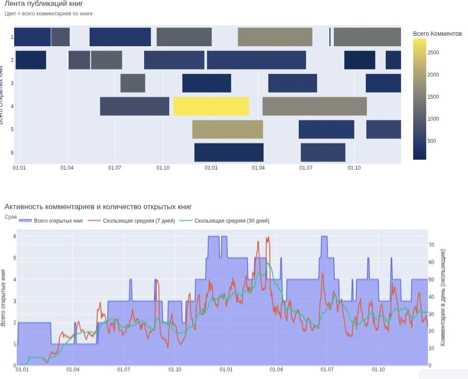
- Publication timeline (Gantt-style): book activity across time, color-coded by engagement volume
- Comment activity tracking: 7-day and 30-day rolling averages alongside book open counts
- Sentiment scoring: tracks whether reader reactions are trending positive or negative
Iterated on the design through weekly feedback sessions with authors throughout the build.
Phase 3: Chrome Extension
A recurring friction point from the interviews was how painful it was to export data from LitNet manually. Built a Chrome extension (“Litnet Stats Collector”) that lets authors fetch their full statistics in one click and download as JSON for direct upload to the dashboard.
This removed the main data-access bottleneck and made more frequent, up-to-date analysis possible.
Impact
Author-reported outcomes from the dashboard:
- Identified comment volume and sentiment as the most actionable success metrics (previously not tracked at all)
- Helped authors figure out the optimal number of concurrent active books, which improved both output and work-life balance
- Gave a clear signal for which books were worth digital ad spend
- UX interview recommendations contributed to a 13% improvement in ad conversion
Key Takeaway
The interviews made clear that the core problem wasn't just a lack of tools. Authors had data available to them but no way to make sense of it, and no clear picture of what success even looked like for them. The priority that emerged was insight generation before anything else: before authors could optimize their work, they needed to understand what was actually driving engagement. Building the dashboard gave them that. Once they could see comment trends, publication timelines, and engagement patterns in one place, a clearer question surfaced: how much time should be spent creating new content versus improving the reach of what already exists? The dashboard made that tradeoff visible. Authors shifted toward spending less time producing new content and more time on marketing and promotion for books that were already performing. That reallocation of effort, driven by the data, is where the real impact came from.